

by Wings and a Wand
Effective Professional Learning must be active and collaborative along with meeting the needs of the audience. My Professional Learning (PL) will consist of in-person and online meetings as a PLC (Professional Learning Community) on a consistent basis to support my Instructional Design to achieve a measureable goal (BHAG) that originated from my 4DX Strategy.
Alternative PL for Blended Learning Emergent Bilingual Instructional Coaching Initiative
Overview: Create an Online Blended Learning Emergent Bilingual (EB) Instructional Coaching Initiative amongst the district’s Elementary EB Instructional Coaches and teachers providing ESL services to promote an authentic learning environment where our elementary EB students have choice, ownership, and voice in their learning. (Horn et al., 2014; Elements, n.d.; Harapnuik et al., 2018)
The 5 Principals of Effective PL in detail for My Alternate PL Model:
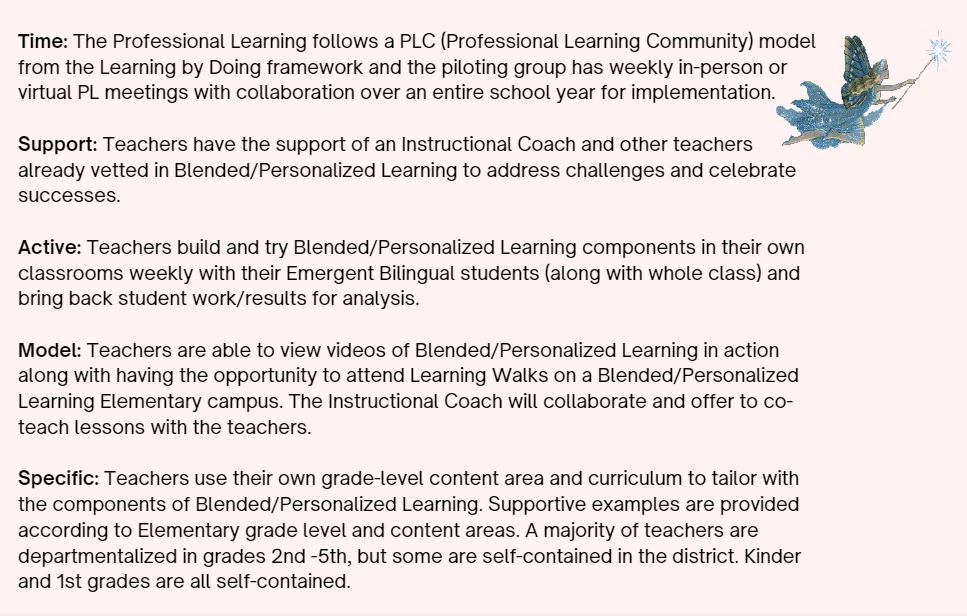
The Instructional Design of my PL is in the form of BHAG & 3 Column Table with the timeline embedded in the 3 column table and also presented in an outline form.
My audience will be lead ESL certified teachers on feeder campuses for the implementation of my Innovation Plan and ESL Certified teachers on my campus participating in my pilot and in the Blended/Personalized Learning District Initiative. Other district EB Instructional Coaches on my coaching team are also invited to participate. These teachers require meetings before and/or after school since district and campus take required PL days. I will provide instructional coaching support online or in-person on campus since I have some flexibility to travel within my feeder.
The role of Facilitator will be the EB Instructional Coach (me). However, other instructional coaches can become the Facilitator in my PL model. Agendas for meetings; Forms for Learning Walks; Surveys of Participants, etc. will be created by the Facilitator with input from participant members.
The Preparation and Foundation/Planning Phases will be led by the Facilitator (the EB Instructional Coach). The application and Implementation PLC meetings will be lead by the Facilitator (the EB Instructional Coach). Campus ESL teachers in the district initiative of Blended/Personalized Learning will lead the activities on the Learning Walks for the feeder campus’ pilot teachers in the Foundation/Planning and Application phases. The Reflection Phase will be led by the Facilitator.
The various types of resources needed include: a LMS (Learning Mangagement System) set up with a course dedicated to this Online Blended Learning EB Instructional Coaching Initiative; Microsoft Office software – Word, Excel, PPt, (with all documents backed up in One Drive to be linked into LMS course); Canva account; laptops for teachers; laptops or ipads for students with recording capabilities; Ed Elements resources from district initiative; campus availability for Learning Walks; Blended Learning resources from print and online.
My BHAG for the Alternative PL is: that learners (fellow educators in this learning environment) will have their Emergent Bilingual students (EBs) grow in language proficiency in each of the 4 domains of Listening, Speaking, Reading, and Writing beginning in 2nd grade in order to be on track to Exit out of state testing after 5th grade through the utilization of Blended/Personalized Learning.
Note: Fellow Educators are lead ESL certified teachers on feeder campuses for the implementation of my Innovation Plan and ESL Certified teachers on my campus participating in my pilot and in the Blended/Personalized Learning District Initiative. Other district EB Instructional Coaches on my coaching team are also invited to participate.
Instructional Design of PL with the BHAG & 3 Column Table
This Instructional Design contains links to presentations, documents, and other resources to support My Alternative PL Plan.

Alternative PL Outline
for
Blended Learning Emergent Bilingual Instructional Coaching Initiative
Overview: Create an Online Blended Learning EB (Emergent Bilingual) Instructional Coaching Initiative amongst the district’s Elementary EB Instructional Coaches and teachers providing ESL services to promote an authentic learning environment where our elementary EB students have choice, ownership, and voice in their learning. (Horn et al., 2014; Elements, n.d.; Harapnuik et al., 2018)
Facilitator – EB Instructional Coach (Angela Deschner) Audience – Fellow Educators/Teachers
Phase 1 – Preparation – Led by Facilitator
- Summer 2024 – Prepare the LMS (new to district in 2023-24 school year) for the initiative’s collaboration, storing, and sharing among teachers providing ESL services
- August 2024 – Proposal Letter to administration
- August 2024 – Connect with Fellow Educators – ESL Lead teachers on feeder campuses for the Pilot of my Innovation Plan and ESL Certified teachers on my campus participating in the Blended/Personalized Learning District Initiative. Utilize “Call to Action” video and pages of ePortfolio
Phase 2 – Foundation/Planning: September 2024 – Led by Facilitator and Teachers in PLC format
- Establish a PLC with Fellow Educators with Norms – determine cohorts
- Meet weekly with ESL lead teachers on other elementary campuses in my feeder
- Meet weekly with my teachers of ESL on my campus participating in my Pilot
- Learning Walk on Facilitator’s Campus of Blended/Personalized Learning in Pilot teachers’ classrooms
- Utilize Blended/Personalized Learning components from Wave 1 and 2 with Ed Elements centered on a Classroom Rotation Model and share the learning environment structure and resources to replicate and differentiate for EB student needs (Elements, n.d.)
Phase 3 – Application with Piloting Educators: October – December 2024 – Led by Facilitator and Teachers in PLC format
- Upload each week innovative methods and resources from my campus teachers of ESL i.e. Peer tutoring videos in Science, SeeSaw literacy response lessons; Goal setting and Reflection notebook items
- Meet weekly with my teachers of ESL on my campus participating in my pilot for Data and Reflection
- Meet weekly with ESL lead teachers in my feeder to collaborate and reflect on learning environment structure and shared resources. Record meeting for uploading to LMS.
Phase 4 – Integration with Implementation on feeder campuses: January – May 2025 – Led by Facilitator and Teachers in PLC format
- ESL lead teachers on elementary campuses in my feeder will commit to a in the Classroom Rotation Model using resources from Blended/Personalized Learning components with Ed Elements that were vetted and shared to promote change in the learning environment toward authentic learning that provides voice, ownership and choice in EB students’ learning (Harapnuik et al., 2018).
- Meet bi-weekly with my teachers of ESL on my campus participating in my pilot for Data and Reflection
- Meet weekly with ESL lead teachers in my feeder to collaborate and reflect on learning environment structure and shared resources. Record meeting for uploading to LMS.
- Offer EB Instructional Coaching support online or in-person
Phase 5 – Reflection: May 2025 – Surveys created by Facilitator
- Survey my teachers of ESL on my campus participating in my pilot
- Survey ESL lead teachers in my feeder
- Use results from survey to update Implementation and Innovative Plan
- Summer 2025– Prepare LMS for the initiative’s collaboration, storing, and sharing among teachers providing ESL services all Elementary EB Instructional Coaches
- August 2025 – Elementary EB Coaching Retreat – present Data and Reflections from the pilot along with the LMS for the initiative’s collaboration, storing, and sharing
References:
Chapman, G. D., & White, P. (2021). The 5 languages of appreciation in the workplace. Woodslane Press.
Chapman, G., & White, P. (n.d.). The languages of appreciation quiz – img1.wsimg.com. Retrieved April 2, 2023, from https://img1.wsimg.com/blobby/go/a0310559-a281-42b3-b07f-42529301ff8d/downloads/languages_of_appreciation_quiz.pdf?ver=1671397699940
Duarte, N. (2010) Five simple rules for creating world changing presentations. Retrieved from: https://youtu.be/hT9GGmundag
Duarte, N. (2010. November 11). Nancy Duarte uncovers common structure of greatest communicators. Retrieved from: https://www.youtube.com/watch?v=1nYFpuc2Umk
Dufour, R., Dufour, R., Eaker, R., Many, T., & Mattos, Mike (2016). Learning by doing: A handbook for professional learning communities at work, third edition. Solution Tree.
Elements, E. (2018). The ultimate personalized learning guide. Education Elements. https://www.edelements.com/personalized-learning
Fink, L. D., PhD. (2005). A self-directed guide to designing courses for significant learning. Retrieved from https://luonline.blackboard.com/bbcswebdav/pid-3042999-dt-content-rid-30108308_1/courses/13583.201810/Self-Directed%20Guide%20to%20Course%20Design%20-%20Fink%20Summary.pdf
Godin, S. [TEDxYouth]. (2012, October 16). Stop stealing dreams [Video file]. Retrieved from https://www.youtube.com/watch?v=sXpbONjV1Jc
Grenny, J. (2012). Crucial conversations. McGraw Hill.
Grenny, J., Patterson, K., Maxfield, D., McMillan, R., & Switzler, A. (2013). Influencer: The new science of leading change, Second Edition. McGraw Hill Professional.
Gulamhussein, A. (2013). Teaching the teachers. effective professional development in an era of high stakes accountability. Retrieved from Center: http://www.centerforpubliceducation.org/system/files/2013-176_ProfessionalDevelopment.pdf
Harapnuik, D. (2015, August 15). Connecting the dots vs. collecting the dots. Retrieved from https://www.youtube.com/watch?time_continue=1&v=85XpexQy68g
Harapnuik, D., Thibodeaux, T., & Cummings, C. (2018). COVA: Choice, ownership, and voice through authentic learning (0.9) [Ebook]. Creative Commons License.
Horn, M. B., Staker, H., & Christensen, C. M. (2014). Blended: Using disruptive innovation to improve schools. Wiley.
McChesney, C., Covey, S., Huling, J., Thele, S., & Walker, B. (2021). The 4 disciplines of execution: revised and updated: achieving your wildly important goals. Simon and Schuster.
Patterson, K., & Grenny, J. (2013). Influencer: The new science of leading change. Second Edition. McGraw-Hill Education.
Sinek, S. (2013, September 29). Start with why. Retrieved from: https://www.youtube.com/watch?v=sioZd3AxmnE
Sinek, S. (2018). How to present properly (Part 5). Retrieved from: https://www.youtube.com/watch?v=msvmLlAkOno&t=32s
Texas Education Agency. (2023, March 13). TELPAS resources. Texas Education Agency. Retrieved April 23, 2023, from https://tea.texas.gov/student-assessment/testing/telpas/telpas-resources
Tucker, C. R., Wycoff, T., & Green, J. T. (2016). Blended learning in action: A practical guide toward sustainable change (Corwin Teaching Essentials) (First). Corwin.
Vogt, M., Echevarria, J. J., & Short, D. J. (2016). Making content comprehensible for english learners (5th ed.). Pearson.Innovative Plan Course Design
 Wings and a Wand