

from Wings & a Wand

“Oh, look! He discovered his hands….” My mom’s words still echo in my mind over the years. As a new mom, getting to know my son as a newborn was such a special time especially after being in education for over a decade and seeing an end to my fertility struggles. Watching him learn was enlightening in the continual formation of my learning philosophy as an educator. Learning is at life’s beginning and continues throughout all of it. I am a life-long learner and want the same thing for my son, my students, and my colleagues, whom I support as an instructional coach. There is also nothing more personal than how a person learns. How we learn well is where controversy arises, and researchers have spent many years dedicating their lives to studying it.
From this research, several learning theories have developed. Behaviorism, Humanism, Cognitivism, Constructivism and Connectivism are some of the main ones (Bates, 2014). Each theory has its own primary contributors: Watson and Skinner for Behaviorism; Dewey, Kolb, and Maslow for Humanism; Plato, Piaget, and Vygotsky for Cognitivism; Dewey, Piaget, Vygotsky, Gagne, and Bruner for Constructivism; and Siemens, Downes and Cormier for Connectivism. While I can see where all can inter-connect with learning, I have leaned more heavily on one theory versus another over the years (Fairbanks, 2021; Hinchliffe et al, 2020; Kotinsky, 2020; Van Aalst et al, 2012).
However, even before discussing the details behind my viewpoint on these learning theories, I have a firmly held belief that learning is NOT done well unless focusing on Maslow’s Hierarchy of Needs first. His beliefs are found in Humanist learning theory (Van Aalst et al, 2012). Criticism has come against this hierarchy and how it is leveled especially with adult learning (Fielding, 2022). In spite of this, my belief is focused on children and their physiological, safety, and affection needs (Abbot, 2023). These are key to learning WELL. Children do not learn well when they are thirsty, hungry, hot or cold. Children do not learn well when they feel unsafe. Children do not learn well when they do not feel accepted. After this, other learning theories can attach themselves to fulfilling the other needs of self-esteem and self-actualization (Abbot, 2020). Bottom line, they have to feel well to learn well.
From personal experience, this belief can be inversely repeated for teachers. Teachers have to feel well to teach well. Teachers do not teach well when they are thirsty, hungry, hot or cold. Teachers do not teach well when they feel unsafe. Teachers do not learn teach well when they do not feel acceptance. Furthermore, to stay in teaching, teachers must have their needs of self-esteem and self-actualization met. Thus, some of my learning (and teaching) philosophy is influenced by Maslow’s contribution to Humanism learning theory.
In the education environment, teaching and learning go hand in hand. They happen together, and if in harmony, they create a collaborative environment. If they are not in harmony, there is chaos. This highlights the difference between a learning philosophy and a teaching philosophy. A learning philosophy is based on how humans learn and a teaching philosophy is a method of instruction to meet the needs of the learner. It is important that these philosophies support each other for the educational process to work.
My Learning Philosophy Journey
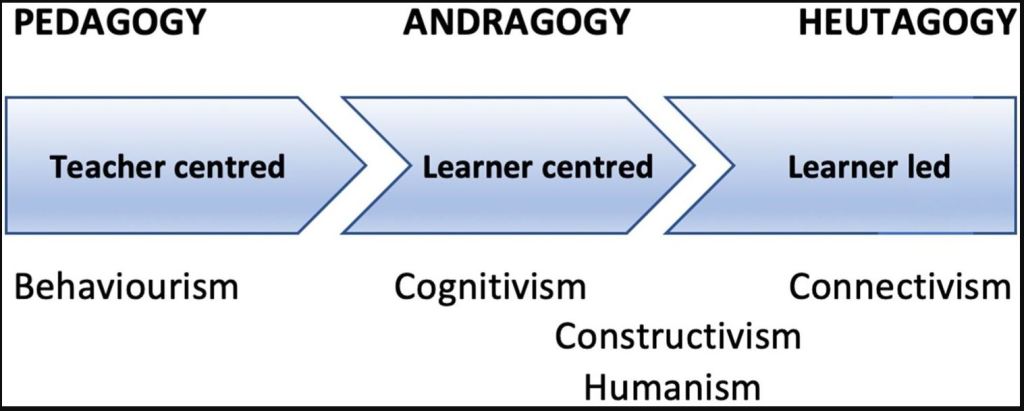
As a new teacher, I leaned more into Behaviorism due to my teacher-centered focus, but have moved to a more Constructivism blended with Cognitivism viewpoint due to my educational journey into Blended/Personalized Learning. I have experienced the harmony between the learner and the teacher in this collaborative learning environment that is learner-centered.
Behaviorism was what the traditional educational environment supported that came from the industrialization model of education to prepare the worker for the world. This was prevalent when I became an elementary school educator and was also the case for me as a student. This was a system of rewards (i.e., grades) for attained knowledge regurgitation from a lecture-based learning environment except in elective courses like Home Economics, Art, Theater Arts, and Photography that I loved. Looking back on the courses that I loved, there were elements of Constructivism in the learning because we learned through experience. When other subject teachers happened to bring this type of learning into their courses, it made the material more enjoyable and memorable.
The joy of learning came back for me as a teacher, too, when I created learning activities with Constructivist elements for my students such as experiments in Science; pioneer campfire activities for Social Studies; baking cookies for a “how to” Writing activity; dressing up as a book character for a guest appearance during Reading instruction. Realizing that this joy could be captured on a continual level in Blended/Personalized Learning that had its basis in Cognitive and Constructivist Learning Theories was a paradigm shift for me.
Theories to Support Blended Learning
First, one needs to understand the history of learning theories that support Blended/Personalized Learning. Jean Piaget was one of the first psychologists to study the brain’s cognitive development from birth to after age 11. He determined that there were four stages of development (Borst, 2023). In one of his initial publications, he looked at the development of a 6- to 7-year-old child through the use of questioning and agreed with other colleagues that “questions in the form of ‘what is…?’ and ‘when?’ are admittedly earlier than ‘whys’. But it can be definitely stated that at the moment when ‘whys’ first make their appearance, a reorganization of values takes place in the child’s mind, which enables us to see more clearly the relations uniting the different categories of questions” (Piaget, 1923). This research was the foundation to determine the move in cognitive development from Preoperational to Concrete Operational stage (Borst, 2023). Piaget “believed children process information differently than adults and that intelligence is not inherent but acquired, adapting and expanding as children investigate the world around them” (Borst, 2023). This philosophy was the foundation of Cognitive Learning Theory. His work has helped the educator to understand where a student is usually cognitively functioning at a certain age in order to create learning opportunities that are appropriate to development whether it is in a traditional school environment or a progressive school environment that Dewey discusses (Dewey, 1938).
John Dewey was a philosopher and educator who studied learning, and when looking at traditional education, asked one of many pivotable questions, “How many students, for example, were rendered callous to ideas, and how many lost the impetus to learn because of the way in which learning was experienced by them?” (Dewey, 1939). He was concerned that the present learning environment in most schools (the traditional industrial model) was not meeting the educational needs of students. Instead, the learning environment was taking away the motivation to learn with the lack of authenticity in the learning. He believed that society needed to improve the learning experience by changing the learning environment. He saw the school as a social environment where education “is a process of living and not a preparation” for it (Dewey, 1897). Dewey believed that activities should build off things that students already know and have experienced. Piaget’s work and Dewey’s work can be linked by how learning is “acquired” (Borst, 2023).
Then, there was Jerome Bruner, a psychologist and educator, who stated, “One thing seems clear: if all students are helped to the full utilization of their intellectual powers, we will have a better chance of surviving as a democracy in an age of enormous technological and social complexity” (Bruner & University Professor Jerome Bruner, 1960/1977). He believed that learning takes place at any age in the same way, same format and that “the difference was in degree, not in kind.” Thus, it was the depth of the learning of the material at each age – not the concept itself that is the focus. He shared that knowledge should be acquired through relatable experiences and not in a “sterilized” environment (Bruner, 1960).
The work of Piaget, Dewey, and Bruner contributed to the Constructivist Learning Theory that “each person reflects on their experience and incorporates the new ideas with their prior knowledge” to obtain learning (Kurt, 2021). Constructivist Learning Theory supports the Blended Learning environment to provide Choice, Ownership and Voice for the learning experience that the learner builds upon to ignite further learning. Educators, who understand this theory, utilize it in their classrooms by understanding the background knowledge that a student brings in order to build on this background knowledge for learning. This theory also supports knowledge being constructed and personal to the learner. Additionally, the learning process is an active and social one with metacognition increasing to reflect on the learning of the learner. Motivation is also pivotal to the process for the learner to maintain engagement in the learning (Kurt, 2021). Seymour Papert added to the Constructivist Learning Theory remarking on how the latest technology in a generation could significantly affect the learning. For him, it was the computer even more than the television that enhanced Constructivist learning through experience for a child (Papert, 1993). His viewpoint promotes the pivotable use of cutting technology in Blended Learning to enhance Choice, Ownership, and Voice (Harapnuik et al., 2018; Horn et al, 2014).
Also supporting Constructivist Learning Theory, there is the Sheltered Instruction Observation Protocol Model that is a research-based model of instruction known for its validity in the past twenty years. One of its major components, Building Background Knowledge, supports new learning concepts being “explicitly” linked to students’ backgrounds and experiences along with past learning to make the content more comprehensible for the learner. This learning model is not only recommended for English Language Learners, who were specifically studied using this model, but for all learners (Vogt, 2016).
My Learning Philosophy in My Innovation Plan
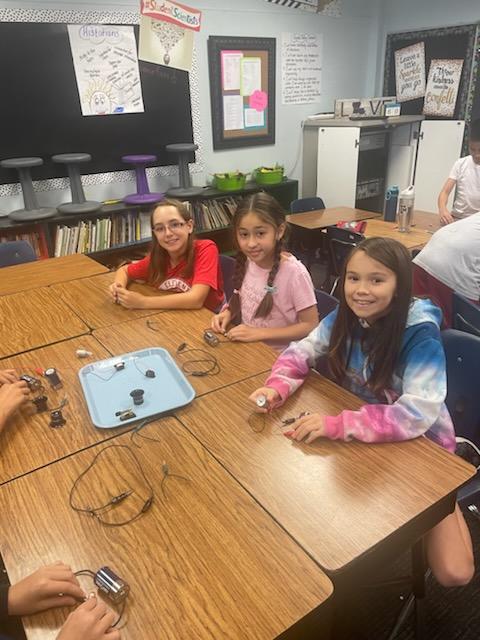
Experiencing Blended/Personalized Learning in action is when my learning philosophy changed. Creating Science station resources for each unit’s Science concepts with a colleague in our campus’ Blended/Personalized Learning initiative and seeing the engaged learning that came from these in small group peer tutoring was a pivotal moment for me. Videoing these stations in action for review or flipped instruction is an espousal of my learning philosophy which backs up my Innovation Plan for Emergent Bilingual learners, who need this Sheltered Instructional support along with others that Blended/Personalized Learning provides.
Additionally, when these students extended their learning by using personal water bottles and books from their backpacks to create their own peer tutoring videos on Science concepts, they were “playing to learn” which fully engaged them (Thomas, 2011). These students felt empowered in their learning due to having “Choice, Ownership and Voice” since various students would latch on to different Science concepts and master them to become peer tutors in that concept themselves. As discussed by Dr. Harapnuik in his personal learning philosophy, this allowed the teacher to move around the classroom as a “learning facilitator” versus lecturing on the concepts (2015, 2021).
Thus, as a catalyst for change, I am inspired to demonstrate how my learning philosophy changed as I share my Innovation Plan along with the evidence of students learning well in conjunction with my teaching philosophy that is supported through Blended/Personalized Learning on my campus.
Annotated Bibliography
Abbot, G., (2020, August 13). Maslow’s hierarchy of needs. How Young Children Learn.
This article discusses Maslow’s hierarchy of needs according to children and their learning. Detailed examples are provided to give the reader a full understanding of his philosophy to support teachers and parents of young children.
Bang-Jensen, V., Lubkowitz, M., & Laminack, L. L. (2017). Sharing books, Talking science: Exploring scientific concepts with children’s literature. Heinemann.
The authors enable the reader to connect children’s literature to scientific discovery. It enables teachers to ask inquiry-based questions while reading from literary pieces. It is a way to embed cross-curricular instruction in the classroom.
Bates, T. (2019, March 17). Learning theories and online learning: Tony Bates. Tony Bates |. https://www.tonybates.ca/2014/07/29/learning-theories-and-online-learning/
The author goes into detail on main learning theories such as Behaviorism, Cognitivism and Constructivism. He discusses how they influence and support online learning that is an important part of education today especially after the Covid pandemic.
Borst, H. (2023, January 19). Piaget’s stages of cognitive development. Forbes Health. https://www.forbes.com/health/mind/piagets-stages-of-cognitive-development/
This book discusses Piaget’s research and cognitive theory in detail with explanation of each stage of development. It gives the educator and parent insight into a child’s development and learning milestones.
Brock, A., & Hundley, H. (2017). The growth mindset playbook: A teacher’s guide to promoting student success. Amsterdam University Press.
This book takes the work of Growth Mindset and goes into detail on how teachers can implement this philosophy in the classroom. It gives real life examples along with suggestions for teachers of various grade levels.
Bruner, J. & University Professor Jerome Bruner. (1977). The process of education: Revised edition. Amsterdam University Press. (Original work published 1960)
This details the work of Jerome Bruner and his philosophy on learning that supports constructivism. He includes a historical perspective along with his personal theories with research regarding education and learning.
Clarke, S. (2019). Visible learning: Feedback. Routledge.
Feedback is a crucial piece for reflection and goal setting as a part of Blended/Personalized Learning. John Hattie’s research in this area is described in this book in tandem with the educational work and practice of Shirley Clarke. This book discusses what is needed to implement a learning environment with impactful feedback for students.
Dewey, J. (1897). My pedagogic creed. School Journal, 54, 77–80.
This is Dewey’s original work that discusses his initial pedagogy regarding education. He goes into the history of education with commentary on his theories.
Dewey, J. (1938). Experience and education. Macmillan.
This is Dewey’s continuing work on learning theory with his pedagogy regarding education. He discusses how his work and research have grown in support of his theory on learning.
Elements, E. (2018). The ultimate personalized learning guide. Education Elements. https://www.edelements.com/personalized-learning
This is the workbook provided by Ed Elements with their description of Blended Learning as Personalized Learning with the 4 Core Elements. There elements included Targeted Instruction, Goal Setting & Reflection, Flexible Path & Pace, Collaboration & Creativity. These elements create Student Ownership of the Learning.
Fairbanks, B. (9 Sept. 2021) 5 educational learning theories and how to apply them: UOPX. University of Phoenix. https://www.phoenix.edu/blog/educational-learning-theories.html#:~:text=There%20are%20five%20primary%20educational,transformative%2C%20social%2C%20and%20experiential
This article discusses five of the learning theories in education in detail. It goes into detail how educators can apply each of them in their work and understand how they effect curriculum and learning enviroments.
Fielding, S. (29 July 2022). What is maslow’s hierarchy of needs?- A deep dive into the research and criticisms. mindbodygreen. https://www.mindbodygreen.com/articles/maslows-hierarchy-of-needs-research
This article goes into Maslow’s work and shares criticisms of it that have developed over time from other learning theories. Criticisms mainly focus on adults who can learn without necessarily having the basic needs met.
Garmston, R., Zimmerman, D. (2013). Lemons to Lemonade: Resolving problems in meetings, workshops, and plcs. Corwin, a Sage Company.
The authors of this book focus more on a business environment vs. an educational environment. The descriptions of what presenters and leaders face in the workplace are detailed and the supports to overcome obstacles are very practical and detailed. The examples used give the readers varied situations that they might encounter while leading a variety of groups in new learning. It is helpful for instructional coaches with presentations.
Grider, C. (1993). Foundations of cognitive theory: A concise review. Information Analyses. https://files.eric.ed.gov/fulltext/ED372324.pdf
This paper discusses the history of cognitive-learning theories and provides a definition and synopsis of cognitive theory with philosophical foundations of Plato and then the work of Wilhelm Wundt is discussed. Next, is the psychology of William James and John Dewey to Jean Piaget’s cognitive growth and development. It also goes into the refinement of Piaget’s theory by Jerome S. Bruner.
Harapnuik, D. (2021, November). Learning Philosophy. Harapnuik.org. https://www.harapnuik.org/?page_id=95
This page on his website discusses his personal learning philosophy and how he derived it from various learning theorists and his own research. He has refined his philosophy over time and continues as new research on learning is published.
Harapnuik, D., Thibodeaux, T., & Cummings, C. (2018). COVA: Choice, ownership, and voice through authentic learning (0.9) [eBook]. Creative Commons License.
This book goes into detail about the COVA learning environment using the concepts of Blended Learning. The reader understands what it meands for the learner to have Choice, Ownership and Voice in Authentic learning environments. It discusses how learners need to be prepared for the 21st century especially in the area of real world problem solving.
Horn, M. B., Staker, H., & Christensen, C. M. (2014). Blended: Using disruptive innovation to improve schools. Wiley.
This book goes into detail about the Blended Learning environment and how it can impact education. It considered this learning environment disruptive to the education practices and environments of today. The authors believe that there needs to be an innovative shift in learning.
Hinchliffe, L., Saunders, L., & Wong, M. (2020, August 1). Learning theories: Understanding how people learn. Illinois Open Publishing Network. https://iopn.library.illinois.edu/pressbooks/instructioninlibraries/chapter/learning-theories-understanding-how-people-learn/
This publication goes through the main learning theories and their theorists. It takes those theories explains the research behind them on how we learn.
Kotinsky, R. (2020, February 12). What is learning? A definition and discussion. infedorg. https://infed.org/learning-theory-models-product-and-process/
This publication discusses learning in a broad sense along with educator opinions. Then, it covers various learning theories including Blooms Taxonomy and how each contribute to the belief of how we learn.
Kurt, S. (2021, February 21). Constructivist learning theory. Educational Technology. https://educationaltechnology.net/constructivist-learning-theory/
This article discusses Constructivist Learning Theory in detail along with the founding theorists that support it. It breaks the theory down into understandable parts from each contributor for the reader to easily understand the theory.
Lockey, A., Conaghan, P., Bland, A., Astin, F. (2021). Educational theory and its application to advanced life support courses: a narrative review. Resuscitation Plus. https://doi.org/10.1016/j.resplu.2020.100053. https://www.sciencedirect.com/science/article/pii/S2666520420300540
This journal article about Advanced Life Support (ALS) courses offers a narrative review of how the application of educational theory has positively influenced ALS course design. The ALS course design has transformed from a lecture-based and behaviorist approach to a more constructivist approach to learning.
Mcleod, S. (2023, June 9). Jean Piaget’s stages of cognitive development & theory. Simply Psychology. https://www.simplypsychology.org/piaget.html
This article goes into Piaget’s research and work on cognitive development and learning theory. It discusses his developmental stages. It also has links to other learning theories that are supportive to educators.
Nottingham, J. (2023). The learning pit. The Learning Pit. https://www.learningpit.org/guide/
This guide defines The Learning Pit that goes with innovation and changes in practice. It focuses on educational environments and explains why there is productive struggle in the learning while undergoing change.
Papert, S. A. (1993). Mindstorms: Children, computers, and powerful ideas by Seymour A. Papert, Basic Books. Basic Books.
This is a book of Papert’s contributions to constructivism in relation to computers as a catalyst for learning. He delves into his beliefs about the crucial resource computers can become in the learning environment.
Piaget, J. (1926). The language and thought of the child. United Kingdom: Kegan, Paul, Trench, Trubner & Company Limited.
This is an original work of Piaget containing his research with children’s cognitive development and language development. It goes into the developmental stages that he founded through his research and in-depth study of children.
Pilar, M. (21 July 2022) The development of behaviorism through watson, pavlov, thorndike, and skinner. Owlcation. https://owlcation.com/social-sciences/Cognitive-Development-in-Children-from-Watson-to-Kohlberg
This article discusses the theorists behind Behaviorism and their contributions to this learning theory. She shares engaging examples of their research and studies that formed each of their philosophies and theories.
Pink, Daniel. (April 1, 2010). Drive: The surprising truth about what motivate us. Retrieved from https://youtu.be/u6XAPnuFjJc
This video discusses what actually motivates us and provides research to support the outcomes. What motivates us is not always predictable such as more money.
Robinson, Ken. (May 24, 2010). Learning revolution. Retrieved from
This video discusses what is needed to meet the learning needs of the 21st century learner and what needs to change for education to get there. We need to think of education to fit the learner not a one size fits all mentality.
Schlechty, P. C. (2011). Engaging students: The next level of working on the work. Jossey-Bass.
Schlechty focuses on building learning communities where students are engaged in their work. He goes into depth on the motivation of students and redefines the role of the teacher in the learning using Seymour Papert’s theoretical work. He goes further in redefining the leadership roles of the learning community: the role of the principal and the superintendent.
Sweeney, D. (2010). Student-centered coaching: A guide for K8 coaches and principals. SAGE Publications.
Diane Sweeney leads Instructional Coaches and Principals into focusing on student work when coaching and leading teachers. Establishing a culture of learning and a focus on student outcomes takes time by building relationships of trust with the teachers. Data is a crucial piece to address in coaching discussions and she helps navigating these conversations.
Thomas, D., & Brown, J. S. (2011). A new culture of learning: Cultivating the imagination for a world of Constant Change. CreateSpace
This book discusses the need for a new learning environment for the 21st century learner in detail. The present culture of learning does not allow a learner to grow at the way and pace needed for our world with all the information available to the learner today.
Thomas, D. (2012, September 12). A New Culture of Learning at TEDxUFM. Retrieved from
This Ted Talk video discusses the author’s book about the need for a new learning environment and provides real world thinking to support its premise.
Tucker, C. R., Wycoff, T., & Green, J. T. (2016). Blended learning in action: A practical guide toward sustainable change (Corwin Teaching Essentials) (First). Corwin.
This is a book that takes Blended Learning and provides a guide to implementation of it in the classroom, school, and district. It gives scenarios and examples to support educators who want to make this change in the learning enviroment to where it continues year after year and not just in a certain classroom with a specific teacher.
Van Aalst, J., Chan, C., and Mu, J. (2012) Theories: History of learning theories. University of Hong Kong. https://kb.edu.hku.hk/learning_theory_history/
This website goes into the history of learning theories and has a page discussing each theory in detail. It has some helpful diagrams to understand the history of learning theories. It discusses the founding theorists of each learning theory in detail.
Vogt, M., Echevarria, J. J., & Short, D. J. (2016). Making content comprehensiblefor english learners (5th ed.). Pearson.
This book contains the founding research and components that make up the Sheltered Instruction Observation Protocol Model that supports the learning of English Language Learners. It is a research based model that has been used for over 20 years to enhance learning and meet the needs of struggling learners not just English Langugage Learners.
 Wings and a Wand